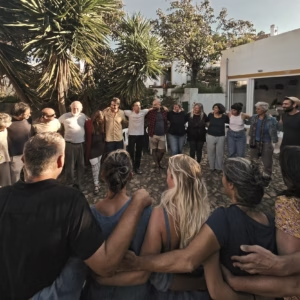
Regeneration: Living in an Ecovillage Part 1
Based on years of field experience, personal encounters, and active involvement in the ecovillage movement, Regeneration: Living in an Ecovillage takes readers on a journey into communities that are exploring new ways of living together. Through their stories, practices, successes, and challenges, this book shows that ecovillages are not utopian dreams but living laboratories where tomorrow’s solutions are already taking shape.
What Is an Ecovillage?
An ecovillage is an intentional community—rural, urban, or based within a traditional village—designed and developed by its residents through a participatory process. Its aim is to integrate the four dimensions of sustainability—social, cultural, ecological, and economic—to regenerate both natural ecosystems and human relationships.
The History of the Movement
The term ecovillage emerged in the early 1990s to describe communities experimenting with sustainable lifestyles based on cooperation, simplicity, and respect for nature. More than a place to live, an ecovillage is a place where people seek to live consciously in harmony with the natural world while reducing their ecological footprint.
The concept gained international recognition at the 1992 Earth Summit in Rio de Janeiro and has since spread across every continent. Today, communities of all sizes are responding to environmental and social challenges by developing more resilient ways of living and improving quality of life.
Every ecovillage is unique. There is no single model or universal certification. Their diversity is one of their greatest strengths, yet they all share the same vision: creating healthier, more supportive lifestyles that integrate the ecological, social, cultural, and economic dimensions of sustainability.
Contrary to common misconceptions, ecovillages are neither sects nor closed communities. They do not promote any particular religion, political ideology, or cultural doctrine. Instead, they generally rely on participatory decision-making and shared governance.
Most ecovillages began as grassroots initiatives, although today traditional villages, municipalities, and even cities are increasingly drawing inspiration from ecovillage principles to support ecological and social transition.
Founded in 1995, the Global Ecovillage Network (GEN) connects these initiatives worldwide, facilitating knowledge sharing and supporting new projects. Joining the network generally requires several years of existence, reflecting the challenge of creating a truly sustainable community.
The Dimensions of Sustainability
Ecovillages recognize that sustainability goes far beyond environmental concerns. Lasting communities must also embrace social, cultural, and economic well-being. Together, these four dimensions form a holistic system capable of regenerating both ecosystems and human relationships.
To promote this integrated approach, the Global Ecovillage Network and Gaia Education have developed educational tools, including the Sustainability Mandala—presented in Part Two of this book—and the Ecovillage Design Education (EDE) programme.
This intensive one-month course combines theory with hands-on practice through a highly participatory learning process and is recognized by UNESCO as a contribution to Education for Sustainable Development.
Box – What Is the EDE Programme?
At the heart of the EDE programme is the collaborative design of a real-life project. Working in small groups, participants develop an idea by integrating the four dimensions of sustainability. At the end of the course, the projects are presented to the local community, where some become reality while others inspire future initiatives.
A Diversity of Approaches
Each ecovillage develops its own priorities according to its history, location, and the aspirations of its residents.
Some focus primarily on ecology through local food systems, organic or permaculture farming, plant-based diets, biodiversity conservation, and natural or low-impact building techniques. Others place greater emphasis on social and cultural innovation by experimenting with new forms of governance, education, conflict resolution, and cooperation.
Community life encourages deep human connections while also requiring personal and collective development practices such as yoga, meditation, creative arts, sharing circles, and compassionate communication.
Economic models are equally diverse. Some ecovillages develop their own businesses and local enterprises, while others combine community living with jobs outside the village. This diversity demonstrates that there is no single blueprint for sustainable living, but many different paths adapted to local needs and cultures.