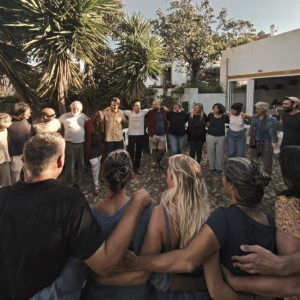
Introduction to the Book Regeneration: Living in an Ecovillage
Regeneration: Living in an Ecovillage is an invitation to discover a global movement that has been exploring new ways of inhabiting the Earth for several decades. Through personal stories, field experiences, practical tools, and inspiring examples, this book presents ecovillages as living laboratories for ecological, social, cultural, and economic transformation. More than a practical guide, it offers a deeper understanding of these pioneering communities and the lessons they can offer to anyone seeking to build more resilient, cooperative, and regenerative ways of life.
The following is the book’s introduction.
Introduction
Let us step back in time.
At a moment of global ecological crisis, humanity stands at a new turning point in its history. Natural resources are being depleted, countless species are disappearing, and biodiversity is in rapid decline.
Industrial monocultures have come to dominate agricultural landscapes. By disrupting the balance of ecosystems, they have depleted soils, driven away the animals and insects essential to healthy ecosystems, and undermined nature’s capacity to regenerate. Increasingly disconnected from the natural world—a source of inner well-being and harmony—people have retreated into cities, abandoning rural areas and gradually losing the knowledge that once enabled humans to live in balance with nature.
As climate change accelerates, humanity faces an immense challenge: to adapt while reducing the scale of the disruption affecting all life on Earth.
“Water, energy, and food are freely available to all humanity when we stop following the laws of finance and return to the logic of nature.”
— Dieter Duhm, co-founder of Tamera (Portugal)
Yet across this same planet, more than 10,000 communities are already experimenting with different ways of living. Around the world, ecovillages are emerging in both rural and urban settings, creating new forms of social organization based on cooperation rather than competition, reducing their ecological footprint, and fostering circular local economies.
Many of these communities draw on the principles of permaculture to understand and work with natural systems rather than against them. Caring for the Earth, caring for people, and sharing resources fairly form the ethical foundation of this approach.
As living laboratories of social and ecological innovation, ecovillages are developing practical responses to today’s environmental challenges. They embrace simpler lifestyles, produce locally, minimize waste, and build homes that respect both people and the environment. Several studies have shown that these communities can reduce their carbon emissions by as much as 50 percent compared with national averages.
Many are also engaging with public institutions and demonstrating that local initiatives can make a meaningful contribution to achieving the United Nations Sustainable Development Goals. At a time when governments are searching for effective responses to the climate emergency, ecovillages offer valuable lessons that deserve greater recognition, support, and wider adoption.
“If just 5% of the European Union’s population became involved in community-based climate mitigation projects, the resulting carbon savings could achieve around 85% of the EU’s emission reduction targets.”
— European TESS Study, 2016
Through these new forms of collective living, fundamental human needs, well-being, kindness, and respect for the living world are placed back at the center of our attention. Ecovillages question many of the assumptions underlying modern society—from education and human relationships to governance and economics—in order to imagine alternatives that enable people to rediscover a simpler, more authentic life in deeper connection with nature.
Read the part 2 in the next article.